


As of 16 October the Platts JKM assessment for December delivery is in the high $29s per million Btu. TTF for November is $28.90. Henry Hub for November is $3.10. A US Gulf Coast cargo, bought at Henry Hub, liquefied, shipped round the Cape of Good Hope and regasified in Japan, costs somewhere between $8 and $9 all-in. That is the whole story of the LNG market in one line, and this post is about what happens to the $21 in between.
The walk
We build the delivered cost of a US cargo from the bottom. Every number is public or a widely quoted contract term; the ranges are real and we will publish the calculator so you can move them yourself.
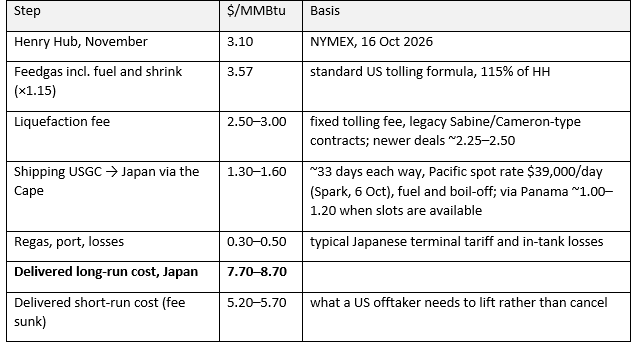
The long-run number is what a new US cargo must earn to justify its existence. The short-run number is what an existing offtaker needs to cover before it is better to pay the fee and leave the gas in Louisiana. Both are a long way below $29.50. Before the war they were a long way below the market too: TTF averaged $14.74 and JKM $15.56 in the first half of 2026, roughly double the walk.
So what is setting the price?
Not the cost of the marginal cargo. There is no spare cargo whose cost could set it. Two Ras Laffan trains, 12.8 mtpa, are out for three to five years. The rest of Qatar’s 77 mtpa is physically intact but, in the CEO’s phrase in mid-October, producing “very little,” with force majeure extended into December and Hormuz traffic still about 75% below February levels. Call it 60 mtpa, roughly 15% of world supply, that the market has learned to live without.
The only way a market lives without 15% of supply is for 15% of demand to go away. That is what JKM is measuring. It is the price at which enough Asian buyers stop buying: Pakistani and Bangladeshi utilities that were 70–99% dependent on Qatar and have gone back to furnace oil, Indian fertiliser plants, Chinese city-gas distributors who have simply stopped tendering for spot. Kpler’s early estimate was 4 Mt of annual demand destruction in South Asia at $15, 2–4 Mt in Southeast Asia at $15–20 and close to 10 Mt in China at $15. At $29, the destruction has gone considerably further than that.
This is the point most coverage misses. The marginal unit in the LNG market in 2026 is not a cargo. It is a megawatt-hour of Asian demand that is being priced out, and the price is wherever that buyer’s alternative sits: the cost of running the oil-fired plant, the cost of the coal unit that was going to be retired, the cost of simply not producing urea this month.
The second mechanism: Asia is competing with Europe for the same ship
There is one supplier whose cargoes have no fixed destination, and that is the United States. Around 17.4 Bcf/d, or about 130 mtpa, left the Gulf Coast in the first half of 2026, and almost every cargo is free to go wherever the netback is highest. So the question of who sets JKM has a second answer: JKM must sit above TTF by at least the freight difference between the two routes, or the ships go to Europe.
Right now they are going to Europe. Spark’s front-month US arbitrage points to Europe, and for February and March 2027 Europe pays over $3 per MMBtu more than Asia on a delivered basis, the strongest signal to Europe since December 2022. Europe’s storage went into the war at the lowest level since 2022 and has been refilling at any price. That is why the JKM–TTF spread has been so thin all autumn while both benchmarks sit near $29: Asia is not paying for scarcity relative to Europe, it is paying the same scarcity premium as Europe and then losing the cargo anyway.
So, for the winter that is about to start, the price of LNG in Asia is being set by two things, neither of which is a cost of supply: the willingness of a South Asian utility to burn oil instead, and the willingness of a German trader to outbid a Korean one for a Sabine Pass cargo.
What changes in 2027
Three things, and they do not all point the same way.
Qatar can come back fast, partially. The damaged trains are gone for years, but the other roughly 64 mtpa of capacity needs only the strait. QatarEnergy says it can be back to normal operations within weeks of Hormuz reopening, and it has at least a dozen empty carriers waiting off Ras Laffan to prove it. On top of that, North Field East Train 1, 8 mtpa, is mechanically ready in November with first production guided to the first quarter of 2027, and the CEO expects “a few” more NFE trains through 2027, with the caveat that every one of them depends on getting equipment through the same strait.
The US keeps growing regardless. The EIA has first-half 2027 exports at 18.7 Bcf/d, about 140 mtpa, up from 17.4 in the first half of 2026. Plaquemines is at full rate, Corpus Christi Stage 3 is on six of seven trains, Golden Pass Train 1 is ramping and Train 2 is due at the end of this year. None of this is contingent on anything in the Gulf.
Shipping stops being a constraint. Fifty-five newbuilds arrived in the first seven months of 2026, another 40–45 are due by December and about 95 in 2027. Spot rates have already collapsed from $287,500 a day at the March peak to $25,750 in the Atlantic and $39,000 in the Pacific. Freight will not rescue the Asia netback; if anything the Cape route gets cheaper.
Two worlds
Hormuz normal by mid-2027. Qatar’s surviving 64 mtpa returns, NFE adds 8–16 mtpa, the US adds another 10, and global supply is up something like 15–20% on the 2026 run-rate within a year. The demand that was destroyed does not all come back; South Asian buyers have learned a lesson about concentration and some of the coal that was un-retired stays on. Price falls until the marginal unit is once again a US cargo, because the US cargo is the one that can be cancelled. That puts JKM back on the walk: 1.15 × Henry Hub plus the fee plus freight, call it $9–12 by the winter of 2027–28 with Henry Hub at the EIA’s $3.50. In this world the interesting questions are American: whether 20 Bcf/d of feedgas pulls Henry Hub above $4 and adds a dollar to the whole curve, and whether second-wave US projects can hold a liquefaction fee under $3.
Hormuz constrained through 2027. Qatar stays partial, NFE slips because the equipment cannot get in, and the marginal unit stays on the demand side. JKM trades in a range set by what Asian buyers will pay before switching, which the last six months suggest is somewhere between $18 and $28, with the floor rising every time a European storage auction clears. Coal regains share in Southeast Asia, China’s spot buyers stay absent, and the projects that took FID in 2024–25 on the promise of a tight 2027 look very clever indeed.
The forward curve is leaning toward the first world. Platts notes that implied volatility for winter 2026–27 JKM is 59–70% against 90–95% for TTF, which is the market saying that Asia normalises faster than Europe. We think that is right, but it is a view about a strait, not about gas, and we would hold it loosely.
What we are watching
Hormuz LNG transits per week, and each QatarEnergy force majeure extension. This is the whole trade.
The JKM–TTF spread against the freight difference of roughly $1.20–1.50. When JKM minus TTF falls below that, US cargoes are going to Europe and Asia is being outbid, whatever the headline price says.
US feedgas above 18 Bcf/d, and Henry Hub against $4. Every dollar on Henry Hub is $1.15 on the delivered walk.
Chinese spot tenders. The day the Chinese city-gas companies return to the spot market is the day the demand-side margin moves up, not down.
NFE Train 1’s first cargo. If it loads on schedule, Qatar’s expansion is real even with the strait half-shut.
What would change our mind
If Hormuz reopens and JKM is still above $20 six months later, we were wrong about demand elasticity: the destruction was structural, the coal is not coming back out, and the market is shorter than the arithmetic suggests. If second-wave US liquefaction fees reprice above $3.50, the long-run walk moves up a dollar and the floor with it. And if Qatar’s surviving trains take months rather than weeks to return, the first world above is a 2028 story, not a 2027 one. We will publish the netback calculator alongside this piece so you can test all three yourself.
