
1. The number
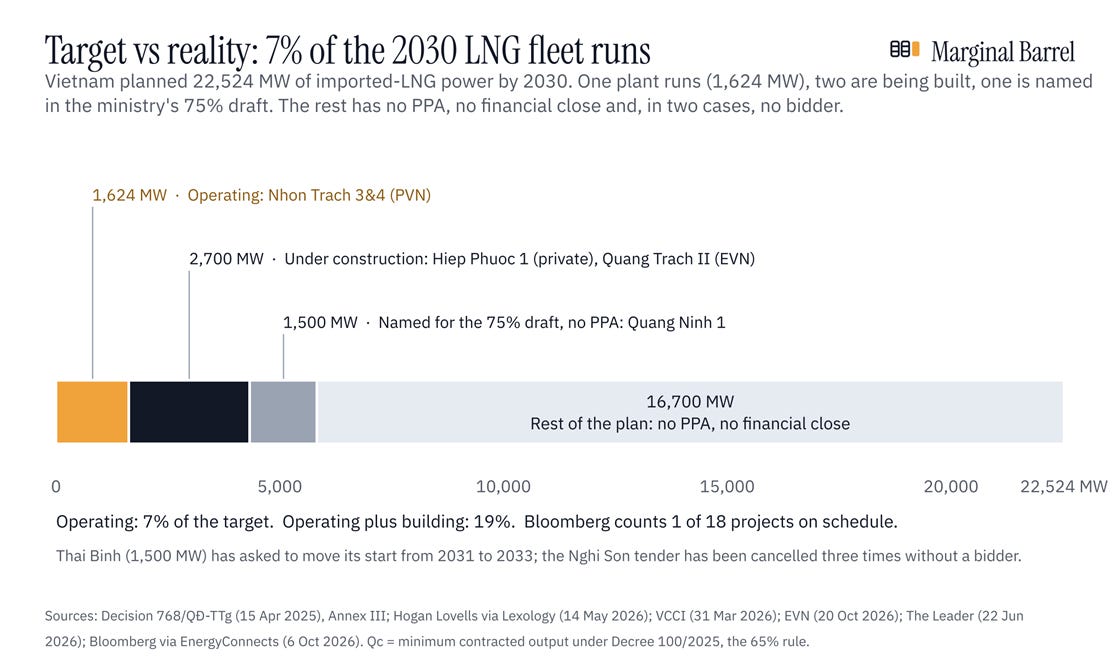
65%. That is the minimum share of a new LNG plant’s expected output that Vietnam’s state buyer must contract for under Decree 100/2025, during loan repayment, for at most ten years. It matters because that one number decides whether 22,524 MW of planned LNG power gets financed, and what Vietnam burns instead. Developers say they cannot finance a plant on it; the buyer says the one plant that runs was over-contracted at it. Both are right. One plant operates, the next megawatt-hour is imported coal, and the retail tariff was cut on 1 November with a shortage forecast for 2027.
2. How the system works
Vietnam runs on coal and water, and it is growing at close to 10% a year. Coal supplies about half of its electricity and swings with the monsoon: more in a dry spring, less once the rains fill the dams. Gas is a small, fixed slice, about 8%, even after the first LNG plants, Nhon Trach 3 and 4, started in January. Domestic gas fields are declining and their replacement, Block B, is a year or more away. So every extra megawatt-hour Vietnam needs is, by default, a coal megawatt-hour, and the coal is increasingly imported: imports have nearly trebled since 2018 and now supply more than half of the coal Vietnam uses.
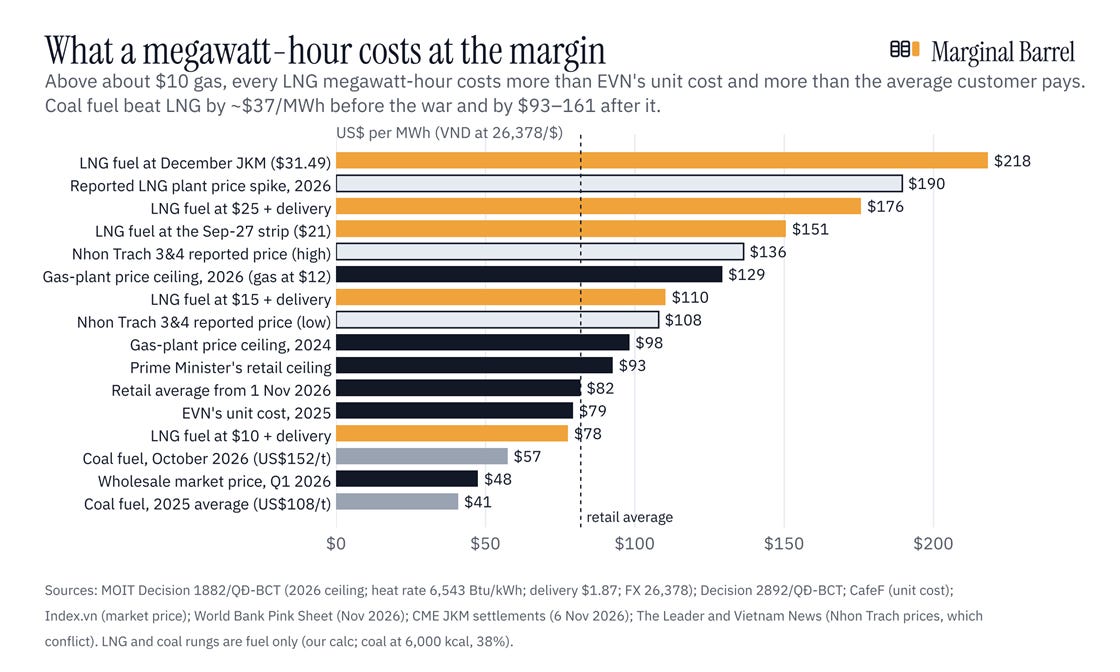
Everyone sells to EVN, the state utility, or into the operator-run wholesale market. The retail price is set by the government inside a published band, and it moved down on 1 November, to VND 2,160 per kilowatt-hour, about US$82 a megawatt-hour. A new LNG plant cannot sell at that. The ministry’s own 2026 price ceiling for a gas plant, built on gas at US$12, is VND 3,411, half as much again; the fuel alone at this week’s spot LNG price costs well over twice the retail average. Chart C2 lays the whole ladder out.
The trade-off is not affordability against climate, and it is not money: EVN made a record profit last year and is sitting on cash. It is who carries the fuel contract. LNG is bought take-or-pay (paid for whether or not it is burned). A power-purchase agreement that guarantees the plant only a share of its output does not mirror that, so a plant the grid wants to run part-time, a mid-merit plant, cannot be financed. That is the whole dispute; the decree answered it with a percentage.