
1. The number
46%. That is how much of the cheap gas Indonesia promised its factories by decree actually reached West Java in the first four months of this year; three years ago nearly all of it arrived. The promise itself had been cut to little more than half the 2023 volume. It matters because Indonesia exports a third of its gas while rationing its own industrial heartland, and the cost is paid by people who never see it on a budget line. What follows is who gets the gas, who pays for the cheap part, and what an honest policy would cost.
2. How the system works
Indonesia is a large gas producer running short at home. Two-thirds of its gas stays in the country; a third goes abroad. Industry, fertiliser plants and power stations share the supply, and a growing part arrives by ship: LNG from the export plants in the east, turned back into gas on floating terminals off Java, because the old fields under West Java are running down. Pipelines delivered a third less gas to industry last year than two years earlier; the replacement costs what LNG costs.
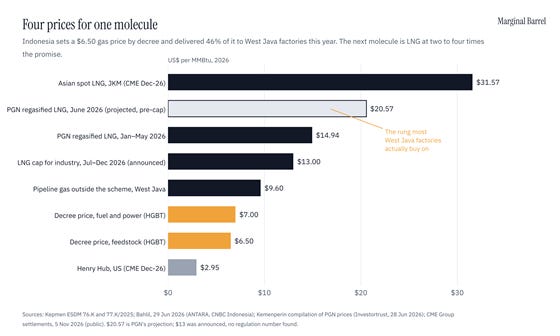
The price depends on who you are. Since 2020 a scheme called HGBT (a fixed cheap price for seven industries, from fertiliser and steel to ceramics and glass) sets gas at $6.50 per MMBtu at the factory gate; power stations pay about the same. Other factories pay a published pipeline price, half as much again. Anyone needing more than their ration buys regasified LNG from PGN, the state distributor, at more than double the decree price; PGN was about to charge three times it in June before the President capped it for the rest of the year. Asian spot LNG trades at more than four times it. Four prices, one molecule; Chart C1 lines them up.
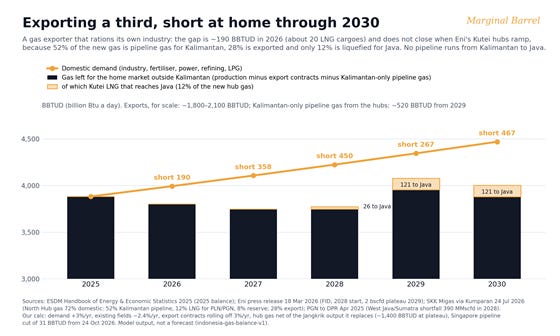
The trade-off is the ration against the budget, not affordability against climate. The deficit is capped by law at 3% of GDP and sits just under it, so every dollar given away on gas cannot be given away on fuel. The squeeze will not ease on its own: demand grows, the old fields shrink, the export contracts do not, and the big new fields off Kalimantan are already allocated, mostly to Kalimantan industry and to export. Only a small liquefied tranche can reach Java, because no pipeline does. Java stays short through 2030.